By Jimmy Kibble
Quicksetts Cobble Rumble Strip Versus Traditional Speed Tables
Engineers and local highway authorities have long wrestled with the question of how to ensure that vehicles use public highways safely and appropriately without unnecessarily disturbing or spoiling the amenities of the environment through which they pass.
The approach road to a Cotswold market town, the residential road in a suburban estate or the main street of a Northumberland conservation village may look and feel very different, but this core question is one that highway engineers face every day. Drivers must slow down, must pay attention, must be cognisant that they are in a place where the primary considerations are pedestrians and cyclists, children and local communities, not vehicular flow.
The physical solutions deployed to that end – their textures, materials, and other design features – must not themselves have the effect of spoiling the amenity of the local environment, through noise (especially in built-up residential areas) or aesthetics (especially in towns and villages of special architectural or historic interest) or, for example, so inconveniencing drivers, causing delays to emergency vehicles or increasing vehicle wear and tear, that they become a source of frustration rather than an effective piece of traffic management.
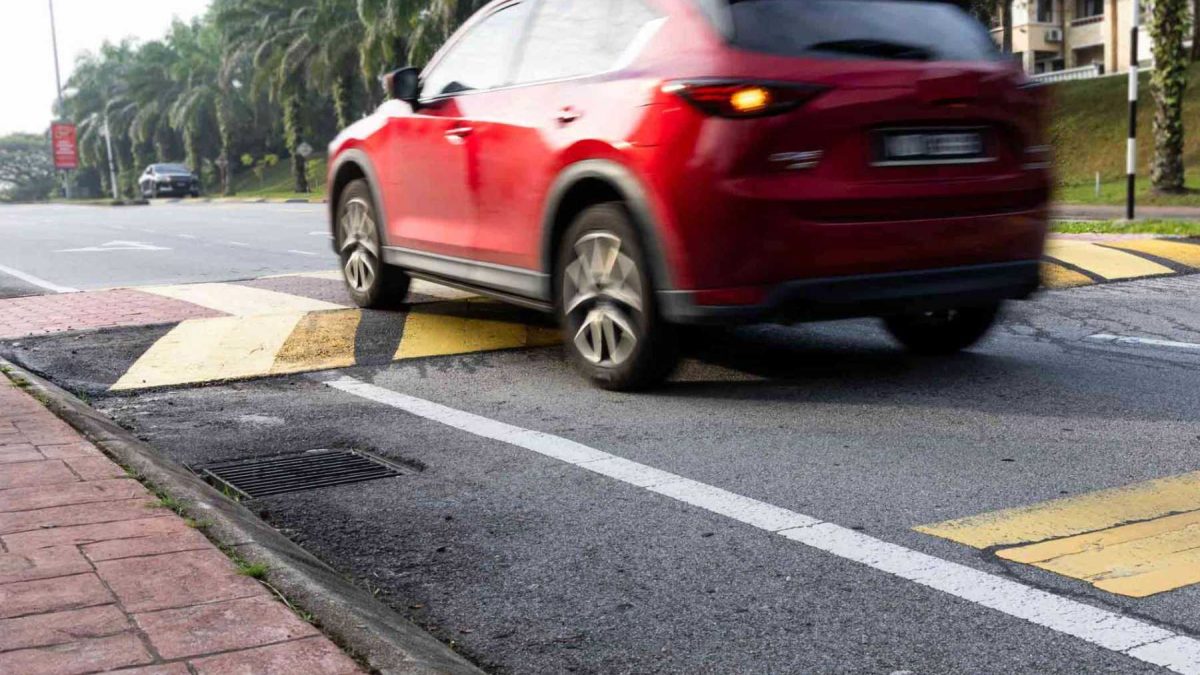
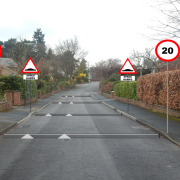
The conventional solution, in almost any setting where vehicle speeds need to be controlled, is for a speed table to be installed at key points on a highway to compel drivers to slow down. Fail to do so, and your vehicle and its occupants will be rewarded by a nasty jolt. It’s an easy, hard, physical solution: think of it as “tell the world to slow down or I’ll hit them over the head with a brick” in action. Speed tables work at the point of delivery, but they have their drawbacks and associated side effects which can damage the quality of life in the very places they’re meant to protect.
An alternative approach, which is starting to be used by increasingly enlightened highway authorities, is the Quicksetts Low Profile Rumble Strips solution. The basic difference between speed tables and rumble strips is that the latter goes beyond simply physically slowing traffic by virtue of an aggressively-deflected carriageway profile to a blend of physical, sensory, visual, and psychological measures designed to encourage and incentivise drivers to slow down, rather than demanding it of them by brute force.
This article will look at what exactly this means, how and why the two solutions differ not just in their physical form but in their entire concept of intervention. It will explore the physics of the consequences on the vehicles and the acoustic environment, the psychology of what makes a driver respond as required to the two different types of system, and actual case studies that are leading more and more highway authorities to install Quicksetts in sensitive locations. The contention here is that speed tables have their place, just as tactile paving has its own special function, but that Quiksetts Low Profile Rumble Strips provide a far more effective solution when these other factors come into play.
The Physical Effects – A Comparison of Impact
So, why are we finding that the Quicksetts rumble strip is a game-changer when it comes to traffic calming in sensitive environments? Well, it all starts with understanding the fundamental physical differences between these two interventions – and how these differences translate into direct, mechanical effects on vehicles, drivers, and the acoustic environment around them.
The Traditional Speed Table: A Physical Mandate
A speed table is a variation on the theme of a speed hump, or raised junction or flat-top hump. As such, the principle is simple. Vehicles must be slowed by a vertical deflection of the carriageway (again a technical term for road surface). The message is non-negotiable. It is physically impossible to drive over a speed table at anything other than a speed significantly lower than before. The mechanics and results of this mandate are brutally direct:
A typical speed table has a typical design that is 75-100mm in height above the surrounding carriageway, with sloping “ramps” at each side and a flat top or plateau section in the middle. By the time a car has descended the near ramp, passed the plateau section, and begun to ascend the far ramp, its chassis will have risen and fallen by a meter or so. That’s a lot of deflection.
For a vehicle that is travelling at the target speed of 20mph or less, the deflection will be smooth and gentle and can be dealt with with a minimal jolt to the occupants. The main sensation will be the noise as they quickly accelerate again. For a vehicle travelling significantly faster than that, this deflection will have one or all of three effects.
The Effects
High-Impact Vibration and Jolt
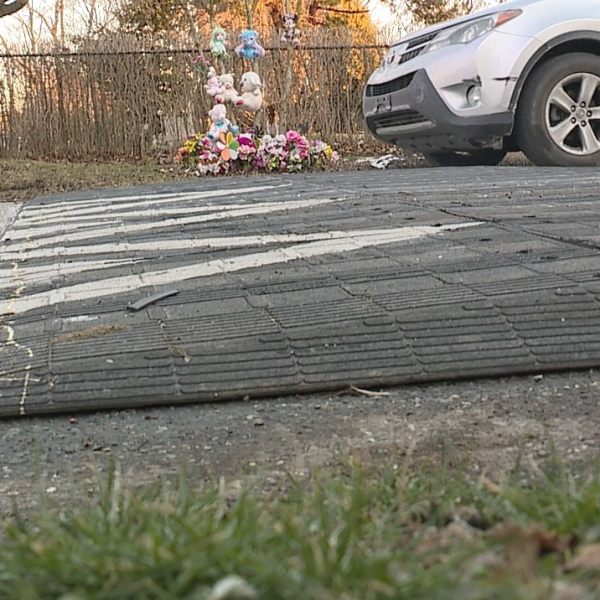
The obvious result of speeding over a speed table is high-impact vibration and jolt. There is no sugar-coating this. This is not a quiet tap on the wrist or a polite request for polite behaviour. This is a loud, very physical punishment delivered to the driver and his car, which is so large and unpleasant that the driver has no option other than to reduce speed. This does bring the speed down, but without changing any of the driving behaviour or attitudes.
Vehicle Wear and Maintenance Concerns
Delivery vans, buses, and other commercial vehicles are much heavier than the average car, with less responsive steering and suspension systems. They also have to do more of it. Constant delivery vehicles will experience thousands of passages over speed tables each year, with a commercial vehicle proportionately higher impact on the vehicles’ chassis, suspension systems, shock absorbers, and the like. Emergency service vehicles that are driving fast on blue lights will tend to accelerate a little more to clear the tables and so put even more force into the tables. Maintenance budgets are stretched enough without being used to fix avoidable vehicle damage.
Noise Generation and Acoustic Pollution
The type of physical impact described above results in a significant noise event. Tyres bounce on the ramps, loose items rattle in the vehicle, suspension systems groan and creak, and drivers accelerate again once past the table. The result is a large increase in overall noise, particularly in residential areas where these tables are most likely to be installed. Whilst residents may not know precisely what is creating these noises, most do realise that it is getting in the way of their sleep.
Drainage Complications and Winter Maintenance
From a highways maintenance perspective, speed tables introduce some more issues. The physical presence of the raised structure can get in the way of the normal drainage gradients, requiring additional gullies or drainage solutions. The raised section can also get in the way of winter maintenance, as snow-ploughs will either have to ride over the tables (which could leave a snow build-up behind) or be repeatedly raised and lowered to avoid the tables. The ramps are a particular issue in winter, as they are the first bit that can become iced over, with a hidden gradient that can catch drivers out.
Installation Disruption
Installation of a traditional speed table will require significant excavation and re-construction of the carriageway surface. The existing surfacing needs to be removed, the raised section built with new material and compaction, and the ramps carefully profiled in the correct gradient. This is not something that can be done without an extended road closure and diversion, with full traffic management required for several days to allow the work to be completed. This can be even more of a problem if a series of these tables are being installed. Extended roadworks have significant disruption impacts for residents and businesses along the route, including the impacts of the traffic being diverted, which will be both larger vehicles and vehicles that will be driving more slowly than normal on unfamiliar roads. Construction time can be weeks for a multiple installation.
Quicksetts Low Profile Rumble Strips: A Tactile Nudge
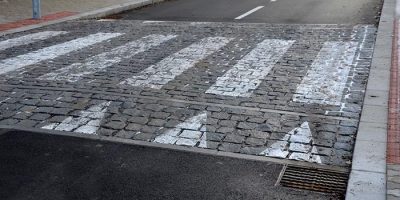
The Quicksetts Low Profile Rumble Strip system, by comparison, approaches the physics of traffic calming in a very different way. The idea of a vertical deflection is replaced by a tactile, multi-sensory intervention that does not force compliance but which alerts and nudges the driver. Quicksetts are granite-effect setts (individual, cobble-like elements with a realistic stone texture) in strips laid across the full carriageway width. The profile is only a few centimetres high, usually between 6mm and 12mm.
As with the height of speed tables above, this low profile actually generates a surprisingly effective cocktail of physical effects that work both separately and together to make drivers slow down without resorting to the disadvantages of traditional humps.
Reduced-Vibration Feedback
The tyres and wheels of a vehicle drive over the Quicksetts strip will create a distinctive multi-sensory message that can be felt in the steering wheel, the seat, the chassis, and the engine. This message is most noticeable at the higher speeds but is present at all speeds – a vibration that is evident but not uncomfortable, present but not alarming. The key difference here is that there is no physical “punishment” at the end of it. The driver has received a controlled rumble – a vibration which is different to that of normal tarmac but is no more unpleasant than driving over regular cobblestones. The physical message being given is “this is a boundary or threshold you are crossing – pay attention” not “this is a speed table, and you just got battered over it”.
Minimised Noise Pollution
As noted in the case study above from Northumberland County Council, the cobble strips provide “a relatively smooth passage for vehicles travelling at appropriate speeds, which lessens the noise experienced by local residents compared to traditional speed humps”. The noise signature, which is so obviously different from a speed table is both quieter and less intrusive. It’s the difference between a “thump-thump” and a rattle. The key thing here is that a rumble strip is most noticeable at the higher speeds. It damps down once you are driving at or under the target speed, whilst a hump gets physically louder and more obvious as you go faster. For the residents whose bedroom windows overlook the Quicksetts system, this is the difference between a good night’s sleep and being repeatedly woken up.
Traffic Flow Maintenance
The traffic flow over the Quicksetts system is considerably smoother than that over speed tables. Vehicles approaching a speed table tend to have to brake more heavily than over a Quicksetts strip. A table needs to be negotiated at a much lower speed than a cobbled rumble strips. The rule of thumb here is that over a hump, a driver might need to slow from 40mph down to 15-20mph, or less, to drive over the table and then accelerate away again. A quicker strip should require them only to reduce from 40mph to 25-30mph and can then maintain that speed. This gives considerably smoother traffic flow with less delay, less acceleration and deceleration, and much lower fuel use and emissions. With all of these added up, a speed table is a heavy metal target that drivers want to avoid hitting, which a Quicksetts strip is not.
Rapid, Non-Disruptive Installation
It is also the case that from a practical, installation perspective, the Quicksetts system has a major advantage over the traditional approach. The low-profile setts can be surface-mounted directly onto existing asphalt carriageways using high-performance adhesives and bonding agents. This means that there is no need for excavation or reconstruction work and much shorter curing or installation times. A typical installation should be able to be completed in a few hours rather than days and the road opened to traffic almost immediately. This rapid installation significantly reduces disruption to residents, businesses, and road users, reduces the costs of traffic management, and allows highways authorities to install traffic calming schemes faster and more responsively.
Durability and Maintenance
Finally, the Quicksetts system has been specifically designed for the rigours of the public highway. The individual setts are manufactured from highly durable materials, with UV-stable colouration, to withstand the daily, lifetime, trafficking of vehicles and the chemical and thermal cycling of all of the added complications of winter road salt, summer temperatures, British weather, and so on. The granite-effect is not just a surface treatment, it is a part of the material, so wear will not reveal a different colour material beneath. The maintenance requirements are close to zero, just occasional inspections and the replacement of individual damaged setts if necessary, and a task that can be achieved quickly and with no major road works.
The Psychological Effects – Communicating with the Driver’s Mind
In addition to the purely physical attributes and comparative advantages of speed tables and Quicksetts rumble strips, it is also useful to consider their effects from a psychological and behavioural perspective, since these are key to understanding their performance in real-world conditions. Traffic calming as a discipline now incorporates a sophisticated understanding of traffic psychology, and the most successful interventions in terms of sustainable speed reduction are those which work with these principles rather than against them. The first three chapters of this section have discussed the physical issues: here, we will examine some of the cognitive aspects.
The Traditional Speed Table in the Driver’s Mind
If a speed table is the language of enforcement, of forcing the motorist to slow down, then a rumble strip such as a Quicksetts can be thought of as the language of communication, persuasion, and conversation. We can consider how each measure works not only in terms of physics, but also of psychology.
The Punitive Message: In the mind of the motorist, a speed table is often perceived as an act of aggression, a provocation or obstacle thrown in the path of the driver by an authority that is likely to be viewed with some suspicion to begin with. As a result, the message that a speed table communicates is often negative from the outset. This is reinforced by the typical deployment process for speed tables, which as noted above is often reactive, in response to a specific accident blackspot or following complaints by local residents. The table is therefore seen as indicative of a problem location or problem behaviour – “This is where bad drivers speed, so we’ve had to put this obstacle here”. In addition, many speed tables are still seen as “punishment for speeders” by drivers, i.e. they’re really aimed at someone who isn’t us.
The Stop-Start Mentality: As noted in Chapter 2, the sharply defined physical nature of speed tables tends to engender a stop-start mentality among drivers. Dramatic speed reduction over and above that which is already dictated by the 20mph limit is required over the physical obstacle itself, with acceleration back to a higher speed acceptable once it has passed. This is what is known in the traffic psychology world as a “point effect” – the influence on speed is localised to the immediate vicinity of the table, and speeds between tables are relatively unaffected. Drivers who are aware of a speed table tend to spot it in the distance and then take the action necessary to cross it at the required speed, but this doesn’t necessarily carry over into a general awareness that this is a zone where such speeds are appropriate and welcome. The table can be seen as a game to be played with – slow down here, speed up there – rather than a reason to rethink one’s driving.
Visual Clash with Context: Finally, particularly in the cases of heritage areas, conservation areas, and other high-sensitivity locations, a speed table can often be quite discordant with the surroundings, both visually and in terms of its role and purpose in the environment. At its most basic, a black asphalt ramp with white/yellow edge lines, often accompanied by warning signs and road studs, sends a clear message – this is a piece of modern engineering intended to solve a traffic problem. Where the street environment itself may otherwise send the message that this is a place of history, of community, of heritage, and of pedestrian priority, the table can feel very much like a symbol of conflict between vehicles and place.
Driver Frustration and Active Non-Compliance: As a result of this and particularly of its punitive nature, speed tables can easily generate frustration and resentment among drivers who feel they are being penalised unfairly or who perceive their intelligence and driving ability to be insulted. This can lead to active forms of non-compliance: from drivers who aggressively accelerate between tables to “make up time lost”, to drivers who swerve their car in order to straddle the centre line if a speed table has been set lower there (as often happens), to drivers who deliberately mount pavements to get around the obstacle entirely. A negative psychological contract between driver and highway authority.
The Quicksetts Approach: Framing the “Gateway”
In sharp contrast, the Quicksetts rumble strip system operates according to a very different psychological model, one which makes use of many of the most important principles of environmental psychology and traffic calming. This model is based on environmental psychology, context and “persuasive infrastructure”, as opposed to punishment or enforcement.
Multi-Sensory Alertness: The studies referenced throughout this report all support the basic principle that the most effective traffic calming measures are those which combine a visual alert with an immediate physical one. The Northumberland case study is explicit on this point, quoting that “the greatest effect on speed reduction is a combination of visual and physical features”. The Quicksetts strip is an example par excellence of this approach. Visually, it creates a distinct difference in surface texture that is visible from a fair distance, particularly where the granite-effect setts are in strong contrast to the surrounding road surface. Physically, the rumble strip provides immediate tactile feedback through the steering wheel and chassis, as well as an acoustic tyre rumble cue. The result is the psychological equivalent of a “salient event” – something which attracts attention and requires cognitive processing without the need for direct attention.
Gateway to the Zone: The gateway effect is one of the most powerful psychological mechanisms of the Quicksetts system, and is referenced in both the Northumberland case study and the French study, the former noting that “the cobble strip breaks up the linearity of the road surfacing” and the latter “accentuation du changement visuel”. In other words, it clearly demarcates between one area and another. Human psychology is profoundly sensitive to these visual and physical cues: there is an almost instinctive sense of crossing from one space into another, and with it an instinctive change in behaviour. Think of how your own behaviour changes automatically when crossing the threshold from a busy main road into a library, a corridor into a cathedral, or a work meeting into a family gathering. The change in physical environment creates a change in psychological space.
Quicksetts cobbles do precisely this in the road environment. As the driver approaches and crosses the strip, the vehicle receives a clear, unspoken signal from the environment: “You are entering a different kind of space now.” This is not a message communicated by signs and markings which have to be consciously read and interpreted: rather, it is a message communicated by the immediate and visceral experience of the road surface itself. The psychological signal is not “slow down or you’ll get a ticket” or “this is where the table is, so slow down over it” – it is “this is a place where different rules and different speeds apply, where greater care and attention are required.”
Aesthetic Priming for Place: This goes hand-in-hand with what is known in the field of cognitive psychology as priming, namely the activation of a network of associations which carry with them specific behaviours and automatic responses. In the case of Quicksetts rumble strips, the visual appearance of the setts primes the driver’s cognitive system with the concept of “heritage town centre”, “market square”, “pedestrianised area”, or “cobblestone street” without this even being consciously recognised. These in turn are associated with different driving behaviours, speeds and states of alertness, creating the expectation that this is a place where pedestrians are likely to predominate, where one’s own speed will be relatively low, and where greater care and attention is appropriate. Through its aesthetic priming, the Quicksetts strip effectively sets the psychological scene for driving in this environment without any need for instruction, enforcement, or indeed any conscious intervention at all. By activating these cognitive and behavioural scripts, the system essentially says to the driver, “We’re now in a different place. Act accordingly.”
Positive Framing: Crucially, and in marked contrast to the often explicitly punitive communication of speed tables, the Quicksetts approach is one of positive framing. The message to the driver is not “you’re doing the wrong thing” or “this is where we’ve decided you have to slow down”, but rather “this is a special place that deserves respect and attention”. This subtle difference in framing has profound effects in terms of driver acceptance, cooperation, and long-term compliance with the speed limit and with expected behaviours. The more a motorist perceives a traffic calming measure as reasonable, as designed with their behaviour and needs in mind, and as contextually appropriate, the more willing they are to both comply willingly in that place and to extend that compliance to surrounding locations and to the 20mph limit in general. This positive psychological contract between highway authority and driver can effectively be summarised as “we’ve created an environment that suggests the appropriate behaviour; we trust you to respond to that appropriately”.
Sustained Behavioural Change: All this amounts to, finally, a much more realistic and practical model of the desired behavioural change. Because the Quicksetts system in effect changes the drivers’ own perception of the environment in which they are travelling – in other words, it changes the “frame” in which the driving experience is situated and the psychological category into which it is placed – it is more likely to lead to a genuine and sustained re-evaluation of speed rather than mere point compliance. The cobble strip gateway can effectively be thought of as the gateway to a broader area, a zone over which the motorist is likely to maintain lower speeds without additional speed reductions at individual sites.
Case Study in Action – Northumberland’s Strategic Choice
The Quicksetts system clearly has numerous advantages from a theoretical standpoint. However, as we all know, the proof of the pudding is in the eating. In other words, real-world applications and case studies are the ultimate test of any engineering solution. The Northumberland County Council experience provides a fascinating case study on how a proactive highway authority approached traffic calming in some of the UK’s most sensitive and picturesque locations.

The Challenge: Balancing Heritage and Modern Needs
Northumberland is a county renowned for its stunning landscapes and historic charm. The county is peppered with villages boasting honey-coloured stone cottages, medieval churches, and winding streets that have developed organically over centuries. Many of these historic villages are located on or near major tourist routes, including the breathtaking coastal road that stretches from Berwick-upon-Tweed to Newcastle. However, with this comes a significant challenge for the county’s highway engineers: how to reduce the speed of traffic entering and leaving these villages without detracting from the very qualities that make them special?
The problem was multi-dimensional. On the one hand, speeding traffic was a genuine safety concern for residents and visitors alike. The risk of accidents and near-misses was particularly acute in village centres, where narrow streets, limited pavements, and high pedestrian activity created potential conflict points. On the other hand, the available solutions, at least in their traditional guises, seemed to create new problems. Speed tables would generate noise pollution that would disturb both residents and visitors—hardly conducive to the peaceful, rural idyll that these villages represent. Standard traffic engineering solutions—black asphalt humps with white markings, arrays of warning signs, road studs, and other paraphernalia—would introduce an overtly urban, engineered aesthetic that would jar against the historic character of the streetscapes.
Northumberland’s villages are not just residential enclaves—they are tourist destinations in their own right and economic assets for the county. The tourism economy in Northumberland is heavily reliant on the perception of these villages as unspoilt, authentic, and peaceful. Traffic calming measures that compromised the visitor experience or detracted from the photogenic qualities of these village streets could have had real economic consequences.
The Failed Experiments: Trial and Error in Practice
Before settling on the Quicksetts solution, Northumberland County Council experimented with various other approaches, all of which, according to the case study, “didn’t achieve the desired results and had varying degrees of negative impact on the visual appeal” of the villages.
The case study notes that previous attempts included “coloured markings, rubber cushions, and interactive signs.” Coloured road markings, often in red or green surfacing to create visual gateways or define special zones, failed to produce sustained speed reduction. They may have caught drivers’ attention initially, but the impact quickly wore off as drivers became habituated to the visual cue. Moreover, the bright colours often looked jarringly out of place in heritage settings, effectively creating a new kind of visual pollution.
Rubber speed cushions, which are like miniature versions of speed tables designed to be spaced with gaps in between, were somewhat more successful. These addressed some concerns about emergency vehicle access (since emergency vehicles with wide axle spacing can often straddle the cushions), but they generated similar issues with noise and vibration as traditional speed tables. The “thump-thump” of tyres meeting the rubber cushions was particularly intrusive in quiet village environments, and the black rubber modules, often with yellow reflective markings, presented a distinctly urban, engineered aesthetic.
Interactive signs, such as vehicle-activated speed warning signs that display drivers’ actual speeds, were also tested. These showed initial promise but suffered from the same habituation effect. Regular commuters quickly learned to ignore the signs, and their effectiveness diminished over time. Moreover, the signs themselves, with their electronic displays and solar panels, introduced modern technological elements into the historic streetscape, creating a sense of visual incongruity.
Each of these experiments taught valuable lessons about what doesn’t work in heritage settings: visual-only cues are subject to habituation, noise-generating solutions create new problems even as they solve others, and solutions that are visually incongruous with their surroundings detract from the very qualities they’re meant to protect.
The Quicksetts Solution: A Multi-Faceted Approach to a Multi-Faceted Problem
Northumberland County Council’s decision to trial Quicksetts Low Profile Rumble Strips was a deliberate and strategic choice. Rather than accepting a trade-off between effectiveness, noise reduction, and aesthetic compatibility, the council chose a solution that could address all three concerns simultaneously. The Quicksetts system was designed to do exactly that.
The implementation strategy was also carefully thought through. Instead of blanket installation throughout entire villages, the council opted for a targeted approach, installing the strips at key gateway locations—typically the point at which approach roads enter the village centres. This not only maximised the psychological “threshold effect” mentioned earlier but also created a clear signal to drivers that they were entering a different kind of environment where different driving behaviours were expected.
The installation process itself is another practical advantage. Traditional speed tables would have necessitated prolonged road closures, significant excavation work, and substantial disruption to residents and tourists. The Quicksetts strips, by contrast, could be installed in a matter of hours with minimal disruption. Temporary road closures would allow the strips to be surface-mounted onto the existing carriageway, after which the road could be re-opened the same day. For villages dependent on tourist traffic, this is itself a significant advantage.
The Verdict: Satisfying a Range of Stakeholders
The continued rollout of the Quicksetts system to multiple locations in the county is a testament to the satisfaction of the council with the results. The case study features a testimonial from the Construction Manager on site, who reiterates the multi-dimensional success of the scheme: speed reduction, noise reduction, and even aesthetic improvement.
It’s worth unpacking this verdict from the perspective of various stakeholder groups. From a pure traffic engineering standpoint, the strips achieved the primary goal of speed reduction. We don’t have specific before-and-after speed data in the case study, but the ongoing rollout indicates that any monitoring done demonstrated effectiveness. Critically, this speed reduction is achieved without the stop-start effect of traditional speed tables, which is a big win in terms of traffic flow characteristics.
From a resident’s point of view, the noise reduction compared to traditional speed tables is a significant quality-of-life win. The “relatively smooth passage” for compliant vehicles means that the traffic calming measure itself doesn’t become a source of noise pollution. Residents can enjoy the benefits of slower traffic without suffering from the acoustic consequences of more aggressive physical interventions.
The heritage and tourism perspective is also important. The granite-effect finish of the strips seems to have enhanced rather than detracted from the village character. Far from appearing as modern engineering intrusions, the strips have a surface finish that reads as contextually appropriate. The overall visual language is one of place-making, not traffic engineering.
Finally, from a highway maintenance and administration perspective, the low maintenance requirements, rapid installation, and durability of the system make it an attractive proposition. The rapid installation also means that multiple locations can be done in a single construction season, allowing the council to implement a coordinated traffic calming strategy across numerous villages in a relatively short time frame. This would have been all but impossible with traditional speed tables.
A Template for Sensitive Environments?
The Northumberland experience provides a useful template for other highway authorities facing similar challenges. The case study serves as a reminder that it’s possible to achieve effective traffic calming without accepting trade-offs on noise pollution or visual impact. It demonstrates that the most successful solutions are those that work with the character of place rather than against it; that leverage psychological mechanisms as much as physical enforcement; and that consider the needs of multiple stakeholder groups simultaneously.
The continued rollout of the system across Northumberland is itself a strong indication that the initial success has been sustained over time—that the strips continue to perform effectively, that they haven’t suffered from premature deterioration or maintenance issues, and that driver and resident acceptance has remained high. This long-term performance is important, as many traffic calming measures show high initial effectiveness that diminishes as drivers habituate to them or as physical deterioration undermines their functionality.