 By Robert Green
Traffic Calming and Emergency Services
The Paradox Behind Public Disputes
Are traffic calming measures really a threat to emergency response times, or do they quietly do some good? It’s a question that has sparked heated public consultations all over the UK and further afield. And the truth is, it’s a bit more complicated than both sides are usually willing to admit.
Traffic calming techniques – especially vertical deflections like speed bumps, speed humps and the like – can add a few seconds to some blue-light journeys. Studies done in Portland in the mid-1990s found that 22-foot speed bumps added 1-3 seconds each for lighter fire engines, and up to 5-7 seconds for heavier ladder trucks. But these same measures can also substantially cut the number and severity of crashes that generate emergency calls in the first place. Evaluations of 20 mph zones in the UK showed 30-40% reductions in injury crashes, with a significant chunk of those prevented incidents being road traffic collisions that would have required fire or ambulance attendance for extrication or medical response.
This creates a bit of a paradox. At public meetings, fire brigade reps often warn that traffic calming will slow down response times. But privately, many fire officers acknowledge that calmed streets reduce the risk to crews and the public, and actually cut the number of road traffic crashes that need urgent attention.
RTCs – that’s road traffic collisions – can account for up to a quarter or even a third of fire service incidents in some areas, so cutting the number of crashes straight away means a reduced operational load.
This article takes a closer look at what NFCC (National Fire Chiefs Council) guidance actually says versus how it’s used in consultations, the difference between response time and arrival time, fire appliance crash data, a case study of a fire service that co-designed traffic calming without compromising performance and the politicking that stops emergency services from publicly supporting measures they know are good in private.
The theory underpinning this whole analysis is that the firefighter who’s objecting to your speed bump in the public meeting is the same firefighter who will be cutting your child out of a car wreck on the road you’re refusing to slow down.
Why Firefighters Seem to Be at Odds with Your Speed Hump
Imagine a typical public consultation in a 30 mph residential street. There are parents at the back clutching photos of kids who’ve almost been hit by speeding cars outside the local primary school, demanding speed humps, raised tables, whatever it takes to slow motor vehicles down. Then a fire officer gets up and says that every speed hump or raised table is going to add precious seconds to a life-or-death emergency. The room gets tense. Residents see speed humps as lifesavers for kids; the fire service appears to be the villain holding things up to protect a few seconds on the clock.
This standoff is what drives so many traffic calming debates. Residents want lower speed limits enforced through physical measures and emergency services are worried about response times. Both sides genuinely believe they’re fighting for the same thing – saving lives – yet they end up on opposite sides of the planning table.
This article is written from the point of view of a road safety and urban design advocate, trying to find a way to reconcile safety for pedestrians and cyclists with the real needs of emergency services. It’s not anti-fire brigade, just trying to understand and bridge the gap between public posturing and private professional knowledge.
When we talk about traffic calming here, we mean stuff like speed bumps and humps, raised tables, chicanes, road narrowing, traffic circles and mini roundabouts, all deployed primarily on 20-30 mph streets since the 80s to reduce vehicle speeds and crash risk:
- Speed bumps (short, sudden cushions, usually around 3-4 inches high)
- Speed humps (longer, more gradual rises over 10-12 feet)
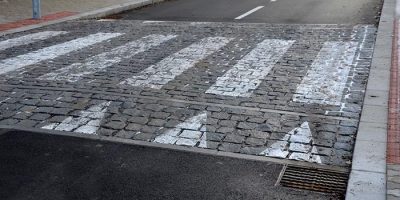
- Raised tables and pedestrian crossings
- Chicanes and road narrowing
- Traffic circles and mini roundabouts
- Modal filters and curb extensions
The NFCC and its predecessor the Chief Fire Officers Association have a significant say in local authority decision making during scheme design and statutory consultation. Their guidance shapes what gets built – and what doesn’t.
The road ahead: we’ll look at what NFCC guidance actually says, the difference between response time and arrival time, fire appliance crash data, a case study of a fire service that co-designed traffic calming without compromising performance and the politicking that stops emergency services from publicly supporting measures they know are good in private.
Types of Traffic Calming: Beyond the Speed Hump Myth
When most people think of traffic calming, the image that pops into their heads is the classic speed hump. But effective traffic calming measures are a lot more than that – there’s a whole range of tools that reduce traffic speeds and improve road safety in different ways. Understanding what’s on offer helps communities and local authorities design traffic calming schemes that actually work and are sensitive to everyone’s needs.
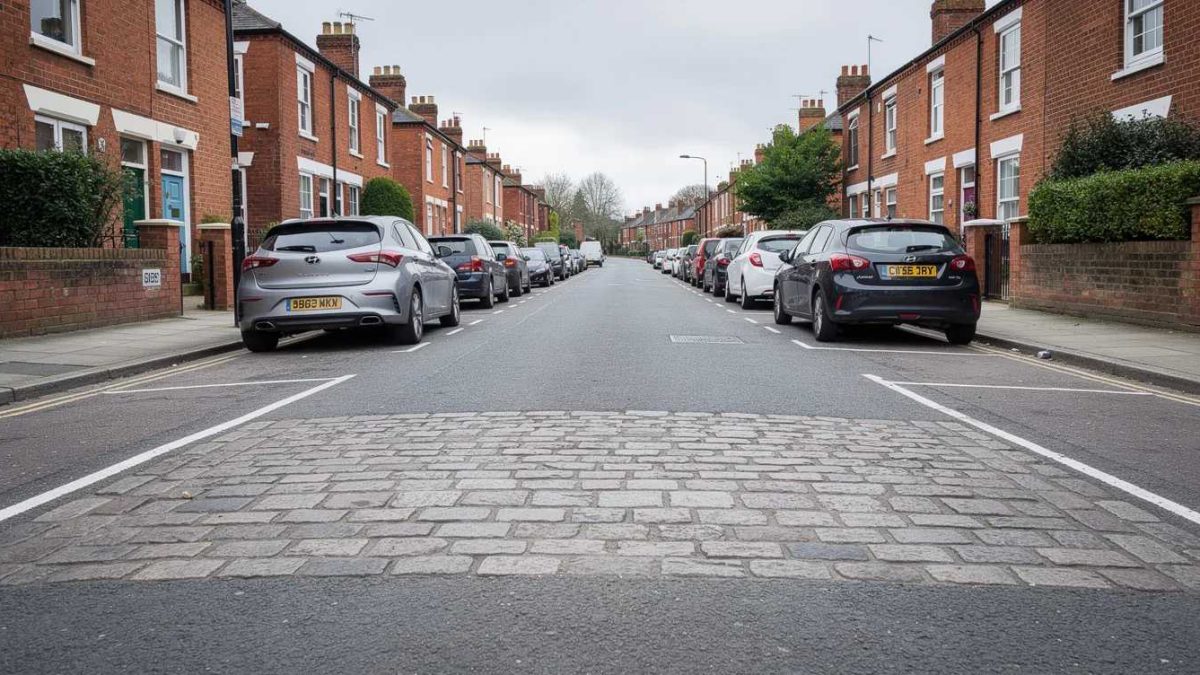
Vertical deflections – probably the most well-known traffic calming measure, are probably the ones that spring to mind first. These include speed humps, speed tables, and speed cushions. Speed humps are essentially just mounds of high ground placed across the road, which gives drivers a little nudge towards slowing down and avoiding a bumpy ride. Speed tables are a bit longer & flat on top – they also serve as raised pedestrian crossings, which is a nice win all round for both pedestrians and drivers alike. Speed cushions, meanwhile, are narrower than your average hump, so they don’t cause too much bother for the fire engines & buses that need to navigate them quickly.
Horizontal deflections change the road itself to encourage drivers to slow down. Examples here include chicanes – a series of gentle curves that make drivers have to take a bit more care with their steering & therefore naturally slow down a notch. Road narrowing – achieved with curb extensions, build-outs or central islands – just effectively chops down the available road space, which gets drivers thinking about slowing down & paying attention to what’s around them. That said, it’s these measures that work particularly well in residential areas where lower speeds are a must for pedestrian safety.
Beyond just changing the road to suit, traffic calming measures also focus on keeping drivers in the picture. Radar speed signs and flashing beacons give drivers instant feedback, reminding them to have a check on their speed. Pedestrian crossings, warning signs & visual cues like coloured surfacing or rumble strips all work together to alert drivers & drive the point home about the need for caution.
The best traffic calming schemes tend to be the ones that bring a few of these approaches together, so drivers are constantly reminded to drive slowly & responsibly. By combining vertical deflections, horizontal deflections & driver alerts, local authorities can get a steady speed reduction, improve road safety and create streets that are just a bit safer & more welcoming for everyone.
The Origins of the Emergency Services Paradox
It all begins decades ago. From the late 80s through the early 2000s the UK went big on large-scale 20 mph zones featuring a lot of speed humps & bumps. Traffic calming measures are put in place to slow down vehicles in areas where pedestrians, cyclists or motorcyclists are around. Often this means residential areas, school zones & near public transport hubs to keep the peace. This period marked the first proper, widespread consultation of fire services on traffic calming schemes. What started off as isolated trials in West Germany & northern Europe started spreading to mainstream environmental & transport planning all over the UK.
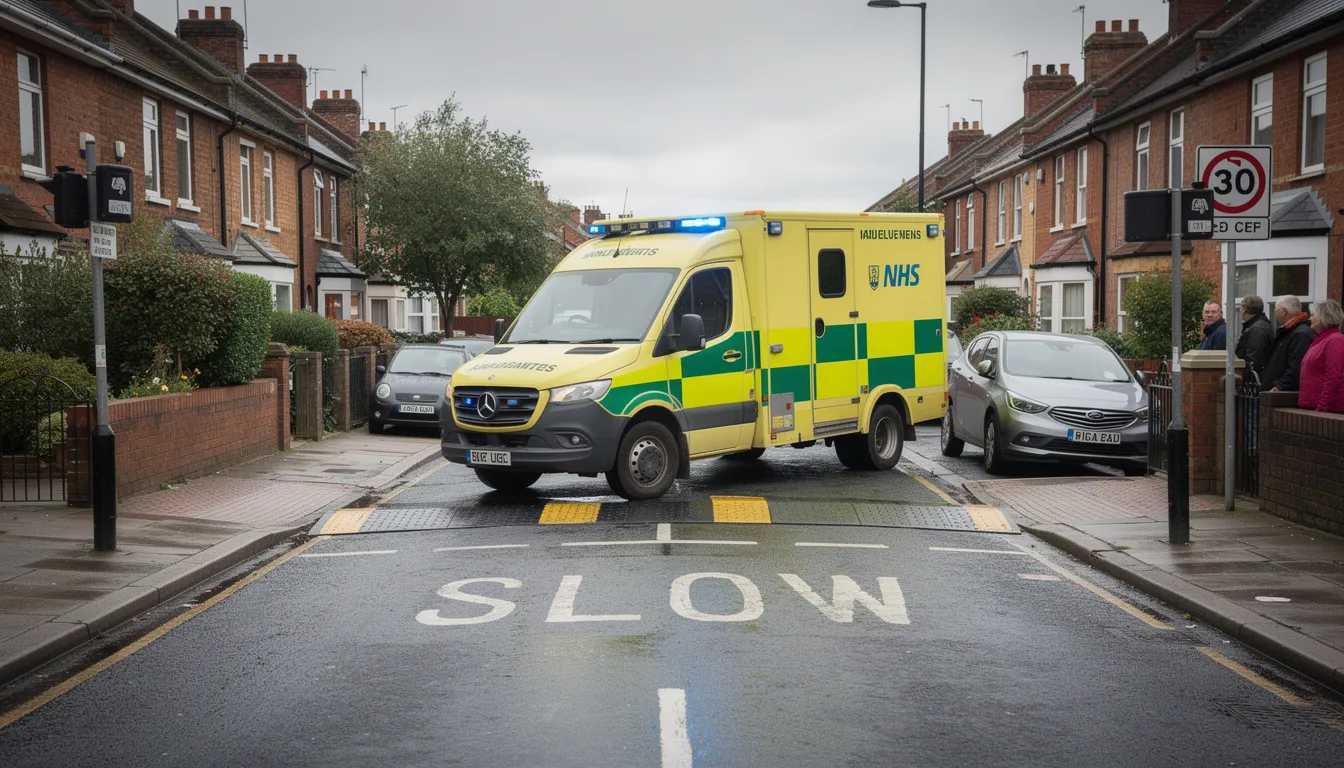
The results from this time were pretty telling. Across the board traffic calming techniques kept injury crashes down by a good 30-40%. Studies on UK 20 mph zones in the 90s & 2000s kept coming back to this same point. Crucially, a decent chunk of those crashes that got prevented would have needed a fire or ambulance to turn up – for extrication, medical help or both. There were fewer accidents, so there were fewer emergency calls, even if a few individual journeys got held up a bit.
The problem is, though, that fire & ambulance services got structured incentives that made them resistant to the idea of this benefit. They get audited and are in the public eye on response times. In England the traditional target for first fire engine to arrive at life-risk fires was 8 minutes. UK ambulance services are answerable to 8 minute targets for life-threatening medical calls too. These targets get published, compared, & scrutinised by local politicians and the press.
This whole framework makes the service go on the defensive. If anything’s going to add a few seconds to a response – especially something visible like speed bumps – then that’s straight away a political & operational risk. The potential net safety effect never makes it into the formal performance frameworks. Response times get measured, counted & added to the local press. “Collisions prevented” is this tricky concept that’s hard to communicate.
Eventually, though, loads of senior fire officers have privately owned up to a pattern. Roads with proper traffic calming generate fewer RTCs. Entrapments go down. Fatalities are less often. Redesign a stretch of road with effective traffic calming & you might add 20-30 seconds to a blue-light run every now & then, but that’s your average yearly chance of stopping multiple severe incidents that would have required the biggest response.
The gap between what fire officers say in public & what they know in private forms the core paradox. The fire officer who warns about response time impacts in a meeting probably genuinely believes in the importance of fast response. And that same officer may also know from years of experience that the roads that are most prone to rat running & have the worst accidents are the ones that are uncalmed & full of speeding drivers.
What NFCC Guidance Really Says About Traffic Calming
The National Fire Chiefs Council, formed from the legacy CFOA, issues operational guidance that significantly influences UK council designs for 20 mph schemes with speed humps and bumps and other traffic calming techniques. NFCC guidance often considers additional measures, such as all-way stops and traffic speed control devices, to enhance pedestrian safety and traffic management. Understanding what this guidance actually says—versus how it is often deployed at consultations—reveals a more nuanced picture than heated public meetings suggest.
The intent of the guidance is not to oppose all forms of traffic calming, but to ensure that emergency response times are not unduly compromised while supporting broader traffic management strategies.
Some traffic calming zones are designed to be self enforcing, relying on physical and visual design to naturally deter excessive speeds without the need for continuous enforcement.
Key Themes in Official Guidance
NFCC and legacy CFOA materials typically address several concerns:
| Concern Area | Typical Guidance Content |
|---|---|
| Vertical deflections | Impact on appliance speed (reductions of 5-15 mph over humps), ride quality, equipment stability |
| Access routes | Emphasis on “unimpeded access” via hump-free primary routes |
| Consultation | Calls for early engagement on scheme design |
| Mitigation options | Wider humps (12-14 feet vs standard 10), sinusoidal profiles, raised tables at crossings |
What the guidance typically does NOT say explicitly is equally important. It rarely states that vertical measures must be completely avoided. It usually allows for design mitigation. It acknowledges that strategic placement—away from junctions, focused on less critical routes—can preserve emergency access while delivering safety benefits.
How Guidance Gets Used in Real Life
At local consultations, bits of NFCC guidance are often cherry-picked. A single sentence about “delays” or “adverse impact” gets snatched out of context to make a point that speed humps and bumps can’t work for emergency response. This completely misunderstands the full guidance, which really:
- Suggests sinusoidal profiles that can reduce forces on vehicles by 20-30%
- Supports longer humps that make for a smoother ride if you’re driving at the right speed
- Endorses raised crossings for intersections – a good alternative to humps
- Advocates for doing some modelling before you even start designing
The guidance also says that speed limit signs and statutory speed limits should be used to support any physical measures you put in place. When designing, you need to think about how different types of vehicles like buses and trucks will cope with the new layout – as well as how to keep all road users safe.
Some of the more interesting bits reference the Fire and Rescue Services Act 2004 and how it points towards prevention and Safe System principles. Then there are the road safety statements that NFCC has put out since 2015 – which say that working with planners and recognising the value of traffic calming techniques is all part of keeping road users safe. There is no rules that say you can’t use vertical measures – but that’s not how they’re often portrayed at residents’ meetings.
Response Time vs Arrival Time: Why Less Calls Matter More than Faster Sirens
The argument over emergency response often comes down to raw minutes and seconds of travel speed – which really isn’t the point. What we should be looking at is: how many high-severity incidents do we actually get in the first place?
Traffic calming is all about slowing people down – and that means fewer crashes and less severe crashes. Interventions like speed humps, roundabouts and lane narrowing can have a real impact on cutting speeding – and that’s linked to fewer crashes. These measures get tested through before-and-after studies to see just how well they work.
What we mean by Response Time and Arrival Time
- Response time: That’s the time from when an alarm goes off to when the fire engines hit the road (typically around 60-90 seconds, plus how long it takes to get there from there)
- Arrival time: The moment when the crew can actually start doing something useful at the scene
The difference is key because response time is only a bit of the picture – prevention is what really makes a difference.
The Workload Reality
UK data from 2010-2020 shows that up to 25-40% of fire and rescue calls are actually just about road collisions, medical emergencies or other special services – not fires. If you reduce the number of crashes in 20 mph zones it cuts that workload. If you sort out traffic calming so that there are fewer crashes then you eliminate the most time-consuming, tricky calls to deal with. But be aware that what you do on one street can affect the roads around it – and that might shift some of the problems to nearby streets.
Take a hypothetical example: a corridor where traffic calming cuts serious injury crashes by 40% – that’s not an unrealistic figure, looking at the evidence from Germany and Denmark. That might save you 6-10 Category A incidents per year while maybe adding a few seconds to the time it takes to get to calls along that road.
The thing is: when you look at how badly people get hurt in major RTCs – the ones with entrapment and severe head or thoracic trauma – time really is of the essence. People often have minutes to get to hospital before it’s too late. But every single crash you prevent by using speed bumps and other measures means that’s one less critical situation you have to deal with.
Network Design is Important
Arrival time also depends on the route the fire engines take, who’s planning the prettiest route and the design of the road network. If you have well-planned grids with slower side streets and agreed emergency corridors you can keep arrival times under control while still having traffic calming everywhere else. Converting roads to single lanes at intersections or junctions is a great way to slow people down – and keep them safe by reducing the amount of road space available.
That Iowa road diet study in Cedar Rapids fire districts was a good example of this – they changed the layout of some roads and found that fire engines were just about as quick to get to calls as they were before – but with lots fewer crashes to deal with.
The Problem with Getting Faster
Saving 10 seconds off a 6 minute response time by driving faster on local streets isn’t going to make much of a difference to the number of people who get hurt on the road. If you cut citywide serious RTC rates by 10-20% through better design then that’s a much bigger deal than getting a few seconds off the response time. The fire service is starting to move away from just about getting to the scene quickly and towards preventing the call in the first place.
Preventing the call is a better way to do it than just getting to the scene fast.## Fire Appliance Collisions : the real cost of these high-speed roads
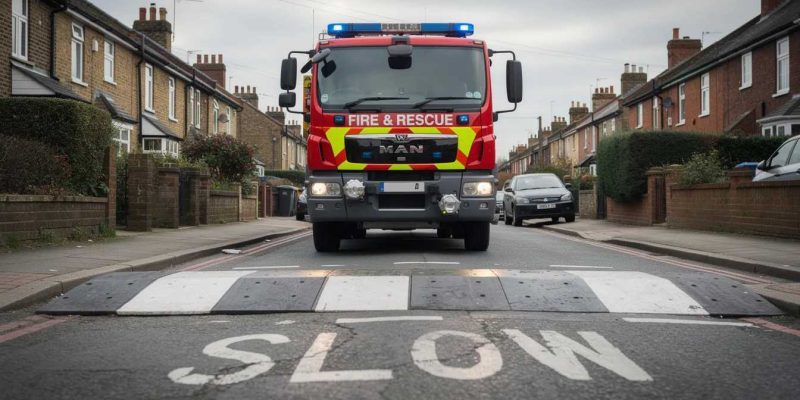
The conversation about traffic calming is almost always about how it slows down emergency vehicles, but rarely do we address the very real danger that regular highways pose to fire crews and the public. You see these massive fire appliances barreling along at top speed on roads that are just not built with their safety in mind, and that’s a real problem. The kinds of traffic calming measures that are typically used – like road humps – can actually be a hindrance to emergency vehicles, by adding precious seconds onto an already tense situation. For every road hump a fire engine hits, it can add an extra six seconds to their response time, which is a critical factor in reaching emergencies on time.
The Unseen Threat
Even though fire appliance crashes are a relatively rare occurrence, when they do happen – and they do, sadly all too often – they’re often quite violent and involve a lot of kinetic energy. The NFPA has documented dozens of firefighter fatalities over the years that were caused by vehicle incidents, and far too many of those were due to rollovers. You see, these massive fire trucks with their high centers of gravity are at constant risk of rolling over when you’ve got to make a hasty turn or slam on the brakes, especially when they’ve got that much momentum built up at high speed. The UK has had its fair share of these sorts of incidents too, and they always seem to be on wide suburban main roads where drivers are often going way too fast.
The physics involved is pretty straightforward – you’ve got these massive fire trucks that are easily 10 to 12 feet tall, and when you hit the brakes at 40 or 50 miles per hour, these things are going to want to roll over every time. Plus, the wider and straighter the road, the faster you can go before you even notice that there’s a hazard on the road ahead, and that’s when the problems start. The force of an impact is directly related to speed, too – a 30 mph impact is going to be half as forceful as a 40 mph impact, so you can just imagine the damage that can be done.
How Traffic Calming Helps Firefighters
When we talk about traffic calming techniques, what we’re really talking about is a whole network of measures – like narrows, raised junctions and even well-spaced speed humps and bumps – that all work together to reduce the overall speed of traffic, the conflict points and even the severity of any crashes that do happen, including those involving fire vehicles. And the beauty of it is, when the whole network is calmed down like that, with most drivers cruising at a more sane 20 to 25 miles per hour, it becomes a lot easier for everyone to predict what’s going to happen next, including the fire crews.
Of course, designers of modern fire appliances have made some significant progress in recent years, taking the impact of speed humps into account when they design them. These days you’ve got all sorts of fancy suspension systems that can handle 20 mph hump profiles with ease, without causing any damage to the equipment or putting the crew in any danger. And it’s worth noting, too, that a lot of training programs now teach fire crews how to navigate speed bumps safely at the right speed, which is helping to dispel the idea that all vertical measures are inherently bad news for fire operations.
A Tale of Two Networks
One of the most compelling studies to have been done on this topic was back in the 1990s, in Portland, where researchers looked at two very different traffic environments side by side. On the one hand, you had a high-speed arterial road where a fire truck with a ladder was travelling at 45 miles per hour when it crashed – and the outcome was very bad indeed. Multiple people were injured in that crash. But on the other hand, they also looked at the same type of fire appliances, the same crews – but in a calmed down neighbourhood where people were driving at a more relaxed 20 to 25 miles per hour. And in that case, the outcome wasn’t anywhere near as bad. The same crashes were happening, but because the speeds were lower, the damage was much less severe. It’s a powerful argument, and one that challenges the assumption that traffic calming is always bad news for emergency services.
Designing Traffic Calming With Emergency Services: A Collaborative Case Study
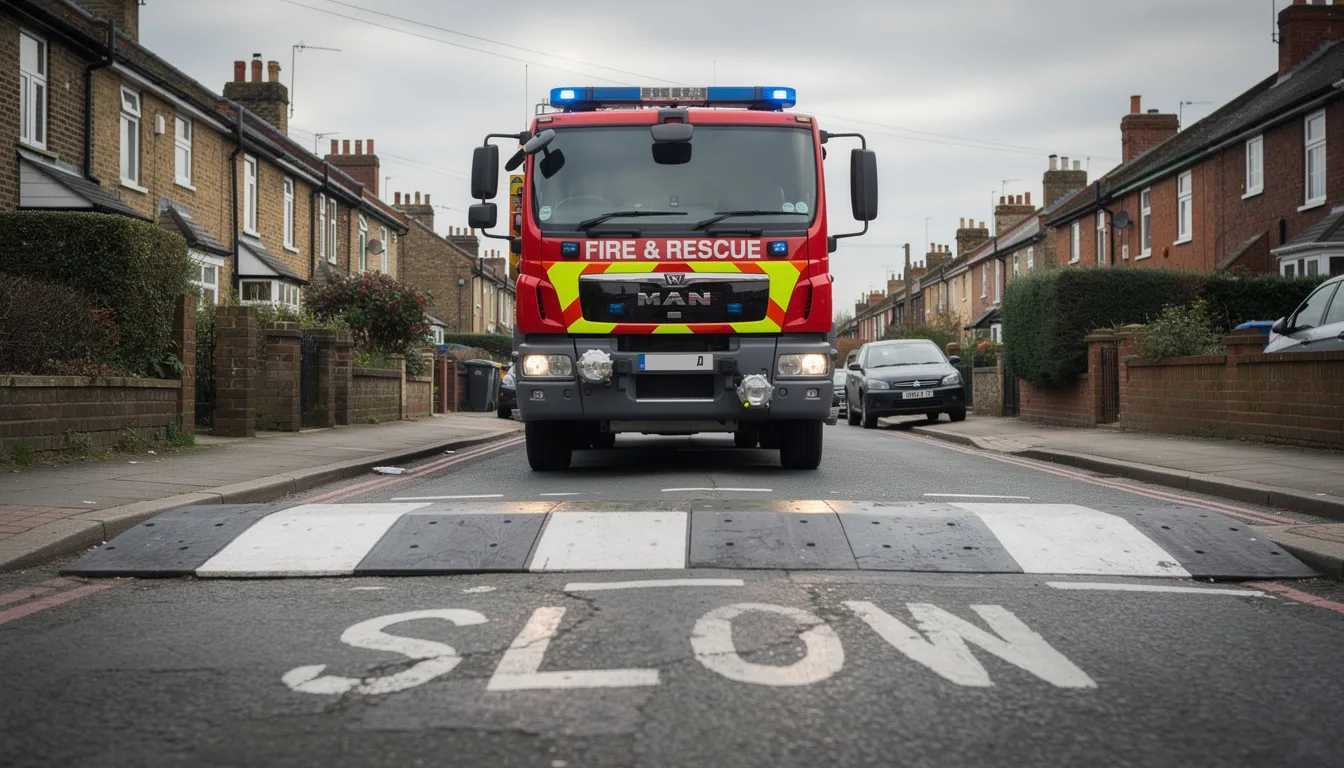
Opposition to traffic calming often stems from being consulted late and presented with rigid designs. Early involvement allows redesign of traffic calming techniques to protect response routes while delivering casualty reduction. For example, incorporating a turning head at the end of a cul-de-sac or in designated turning areas can facilitate vehicle maneuvers, improve safety, and help control vehicle movement, which also enhances pedestrian safety at junctions or dead-end streets. The following case study, based on Bristol’s 2010-2015 20 mph programme in residential districts, demonstrates what collaboration can achieve.
Local Context
The target area comprised residential rat-runs near a hospital and fire station. The streets had a history of pedestrian casualties, averaging 12 KSIs (killed or seriously injured) per year between 2009 and 2013 on the main corridor. Political commitment to 20 mph limits was strong, but so was fire service concern about vertical deflections affecting response to nearby healthcare facilities.
The Co-Design Process
Rather than presenting a completed scheme for comment, planners engaged fire and ambulance services from initial concept stage. The process included:
- Mapping primary response routes: Identifying which streets carried most emergency traffic
- Modelling response times: Comparing scenarios with and without vertical deflections
- Trial installations: Testing sinusoidal speed humps and bumps with wider profiles to reduce discomfort at 20 mph
- Agreed corridors: Designating “hump-free” emergency routes where alternative calming (chicanes, median islands, raised junction entries) provided speed reduction without vertical impact
Design Specifications
The scheme employed specific technical solutions:
| Feature | Specification |
|---|---|
| Hump profile | Sinusoidal, 100mm wide with gradual ramps |
| Hump spacing | 60-80 metres apart |
| Junction treatment | Plateau tables at key crossings |
| Noise mitigation | Aligning humps with property boundaries |
| Turning radii | Maintained for modern appliance dimensions |
Outcomes Over Five Years
Post-implementation monitoring over the course of five years (2015-2020) showed some real improvements:
- Injury collisions: Not only did they fall 42% – that’s from 12 to 7 KSI incidents per year
- Average speeds: The average speed dropped from 32 mph to 21 mph – a pretty significant drop
- Response times: Well, response times didn’t change a whole lot – mean arrival for life-risk calls was 7:42, then 7:51 afterwards. Not a huge difference
- Crew feedback: At first, firefighters were a bit sceptical about the impact of ride humps on emergency response times. But later on, they were reporting fewer high-velocity hazards and fewer severe RTCs – which was a welcome change
The really interesting thing was the qualitative feedback. Firefighters who had initially been against the scheme were later reporting that they were attending fewer child pedestrian crashes on streets which used to be notorious for them. By reducing the number of severe trauma incidents, the benefits of the scheme outweighed any frustration with slightly slower travel on some routes.
The False Binary Exposed
This case shows that the idea that there’s a choice to be made between road safety and emergency access is a false one. When transport engineers and fire officers work together as a team to design the scheme, you can achieve both objectives: reducing casualties and maintaining emergency response performance. The key is to treat fire services as partners rather than just people to be consulted.
Monitoring and Evaluation: Measuring What Really Matters
Implementing traffic calming measures is just the start – what’s also important is understanding the real-world impact. Monitoring and evaluation are crucial to make sure that traffic calming schemes actually do what they’re meant to do: reduce traffic speeds, improve road safety and create safer streets for all road users.
Before you put in any traffic calming measures, you need to collect baseline data on traffic volumes, average speeds and accident rates. After you’ve installed them, you keep on tracking these indicators: changes in average speed, how many vehicles are using the road and how often there are collisions – particularly those that result in pedestrian fatalities or serious injuries. It’s only by using real data that you can get a clear idea of how effective various traffic calming measures are.
Some of the key things local authorities want to measure include reductions in average speed, a decrease in the number of vehicles using the road, and a drop in serious injuries and pedestrian fatalities. Effective traffic calming isn’t just about slowing cars down – it’s about creating safer streets for everyone, including pedestrians, cyclists and public transport users. Regularly assessing performance helps you see which measures are working and where you need to tweak things to get better results.
Working with the community is also a key part of this process. Local residents, bus operators and emergency services all have valuable insights on how traffic calming measures are affecting their daily lives and operations. For example, bus operators might highlight the impact of speed humps on service reliability, while emergency services can flag up any issues with response times. By getting feedback from these stakeholders, local authorities can refine their traffic calming strategies to fit everyone’s needs.
Ultimately, ongoing monitoring and evaluation ensures that traffic calming measures stay effective and stay responsive to changing conditions. By focusing on real outcomes – lower speeds, fewer crashes and safer streets – cities can create environments where responsible driving is the norm and everyone can get around safely, on foot, by bike or in a car.
Political Pressures: Why Fire Services Can’t Publicly Give Speed Bumps the Thumbs Up
To understand why fire services maintain public opposition even though they privately support traffic calming measures, you need to look at the political environment they operate in. Local authorities like Devon County Council develop and publish traffic calming guidelines and policies, which shape the way emergency services and communities interact.
The Accountability Landscape
Local fire and rescue services face a range of accountability pressures:
- Elected members scrutinising their performance data\
- Local press ready to sensationalise any delayed-response stories\
- Performance league tables comparing authorities\
- High-profile fatal incidents triggering inquests and investigations
A fire chief who publicly endorses speed tables and bumps risks being blamed if, years later, a tragic fire or cardiac arrest occurs, and neighbours complain about the slow-down the humps caused. The political calculation is all about playing it safe.
Media Oversimplification
Local media often simplifies things to the point where they’re not true. A single story about an ambulance “stuck on a hump” can make headlines, and drown out robust evidence that traffic calming techniques cut child pedestrian fatalities on that very street. The prevented deaths don’t make the news; the perceived delay does.
In 2024, a survey found that 49.5% of emergency agencies reported worsening response times – and blamed congestion, not traffic calming. But in the heat of a front-page story, nuance gets lost.
Internal Culture and External Communications
Many frontline firefighters are drivers and parents themselves. They’ve seen the damage that uncalmed distributor roads can cause – and privately, they might welcome measures that prevent these tragedies. But when it comes to public communications, the message is tightly controlled and risk-averse.
Response times are explicit, salient numbers. “Collisions prevented” is harder to communicate – and rarely makes it into formal performance frameworks. The metrics shape the message.
Silent Successes
Every year a street that used to be a nightmare to drive on, but never sees a kid getting hurt – that’s a rare story you won’t see on the news. A school run that goes by without a car mounting the kerb – that’s a pretty unremarkable day. These are the “silent successes” of traffic calming – benefits that turn up without anyone even noticing.
And then, suddenly, one fire engine is a bit delayed and it’s front-page news, even if it’s got nothing to do with the speed bumps. It’s like there’s this warping of the public’s attention that shapes the way institutions behave.
The same firefighter who’s out there publicly trashing your new raised table might be quietly relieved that they won’t have to be cutting the neighbour’s kid out of a wrecked car at that junction in five years’ time. They just can’t put that out in public.
Reconciling Safer Streets with Emergency Response: Some Design Principles To Live By
If you’re a local authority or a campaigner trying to get traffic calming put in while still taking into account the needs of the emergency services, the following principles should be useful to you.
Traffic calming does loads more than just reduce the chance of accidents – it can also cut air pollution by getting rid of those nasty vehicle emissions and making the air cleaner in cities. Some traffic calming methods even influence noise levels – some will knock down the noise pollution, while others, like rumble strips, might actually make it worse depending on how they’re put in.
Modern traffic management is all about using things like traffic lights and dynamic speed systems (like vehicle-activated signs) to keep traffic flowing and make the roads safer.
Research shows that traffic calming can actually boost the local economy by saving lives and cutting injuries, which brings in more cash. It can also get people spending more locally and make property values go up by making streets more inviting for pedestrians and cyclists. And let’s not forget you can save 10.7 cents per vehicle mile driven on local roads because of reduced accidents and injuries.
Starting an Honest Conversation Early
Get in touch with the fire and ambulance services at the very start of your project, before you’ve nailed down any designs. Show them what you’re thinking, chat about any worries they might have, and see if you can incorporate their feedback into what you’re doing. A lot of the opposition to traffic calming seems to stem from feeling like they haven’t been included, rather than actual problems with the design.
Mapping Out the Emergency Response Routes
Team up with the emergency services to identify:
- The roads that see the most emergency traffic
- The routes to hospitals, stations and the places that get the most emergency calls
- The corridors where even a tiny delay would add up to a big problem because of all the daily traffic
Focus the speed humps and tables on the residential areas where emergency traffic isn’t as big a problem. Then use other calming methods on the strategic corridors that really matter.
Design Tweaks That Make a Difference
Various traffic calming measures can be adjusted for emergency access:
| Feature | Standard Approach | Emergency-Friendly Variant |
|---|---|---|
| Hump height | 100mm | 75mm with longer ramps |
| Hump spacing | 40-50m | 60-80m |
| Hump position | Mid-block | Before junctions (controlling approach) |
| Hump profile | Flat top humps | Sinusoidal curves |
| Speed cushions | Full width | Wheel-track spacing for wide-axle vehicles |
Speed tables and raised pedestrian crossings can provide vertical deflection at key crossing points while maintaining smoother links between them. Traffic circles and mini roundabouts offer horizontal deflection as an alternative to vertical measures.
Technology and Operations
Modern solutions extend beyond physical design:
- Route-optimisation software that prefers hump-free arterials
- Pre-planned “blue routes” agreed between services and planners
- Two-tier response: Smaller rapid-response vehicles using calmed streets, larger appliances using designated corridors
- GPS-enabled emergency vehicle preemption (EVP): 60% of responders expect 10+ second gains from signal pre-emption
The Evidence Base
Evidence from multiple countries—UK, Germany, Denmark, New Zealand—confirms that well-designed area-wide traffic calming techniques reduce speed and collisions without measurable deterioration in emergency service outcomes at network scale. The fear of catastrophic delay is not supported by systematic data.
Once politics is set aside, both road safety advocates and fire brigades share the same goal: fewer people killed or seriously hurt, including on the way to the incident.
Conclusion
The supposed conflict between traffic calming techniques and effective emergency response is largely a product of metrics, politics, and misinterpretation of guidance. When we examine the evidence rather than the rhetoric, a different picture emerges.
Speed tables and bumps, when thoughtfully designed and placed, are associated with substantial reductions in serious collisions—the very incidents that consume the most urgent fire and ambulance resources. Area-wide schemes that cut injury crashes by 30-40% eliminate dozens of time-critical emergencies over their lifespan. The seconds occasionally added to remaining journeys pale against the incidents never attended because they never occurred.
The emergency services paradox persists because institutional incentives and political pressures reward caution over nuance. Publicly, fire brigades are compelled to emphasise any potential delay risk. Privately, many officers understand that calmed streets mean fewer body recoveries, fewer traumatic rescues, fewer children cut from wrecked cars.