 By
By 12 Questions to Ask Before Hiring a Tarmac Driveway Contractor in the UK
I’ll start with a confession. Some of the worst asphalt I’ve ever seen wasn’t on a motorway or a council estate. It was on people’s driveways. Lovely houses, proud owners, and a black surface that was cracking, sinking and sprouting dandelions within eighteen months.
The frustrating thing is that a tarmac driveway, done properly, is a brilliant choice. It’s quick to lay, it’s quieter underfoot than block paving, it handles cars well and it’s easy to repair. Done badly, it’s a few thousand pounds of disappointment poured over a bed of soil.
The difference almost never comes down to the material. It comes down to the contractor, and specifically to what happens underneath the bit you can see. A shiny black finish hides a multitude of sins. By the time those sins show up, the van with no business name on the side is long gone.
So before you sign anything, I want you to put these twelve questions to every contractor you’re considering. A good firm will answer them happily and in detail. A cowboy will get vague, defensive or suddenly very keen to talk about the discount that “only applies if you book today”. Either way, you’ll learn a lot.
One quick note on language. Most people say “tarmac” and most contractors do too, so I will. Technically what you’re getting is a bitumen-bound asphalt, but don’t let anyone bamboozle you with terminology. The questions below are what matter.
1. “Where are you based, and can I see jobs you did a few years ago?”
Start with the basics, because the basics weed out half the problem. You want a proper business address, a landline or at least a consistent mobile number, a website with real photos, and public liability insurance they’ll show you on request.
Then ask for references, and not just last month’s jobs. Anyone can make a driveway look good on day one. I want to see a drive they laid three or four years ago. That’s when bad sub-bases, poor drainage and thin surfacing reveal themselves. A firm that’s proud of its work will happily give you an address to drive past. If they only have glossy photos of freshly laid jobs, ask yourself why.
Membership of a trade scheme such as TrustMark, or your local Trading Standards-backed scheme, is a nice bonus. It isn’t a guarantee of quality, but it does mean someone is watching.
2. “How deep will you dig, and what goes into the sub-base?”
This is the single most important question on the list. Ninety per cent of driveway failures I’ve looked at come down to what’s underneath.
For a normal domestic drive carrying cars, you’d expect the contractor to dig out the topsoil and soft ground, then lay a sub-base of crushed stone. Usually that’s Type 1 (sometimes called MOT Type 1), around 150 mm deep, compacted in layers. If the ground is soft clay, or you’re parking a heavy van or motorhome, it should be deeper. Many good contractors also lay a geotextile membrane first to stop the stone sinking into the soil and to suppress weeds.
What you don’t want to hear is “we’ll just go over the top of what’s there”. Laying fresh tarmac on a cracked old concrete drive or loose gravel is asking for trouble. Sometimes overlaying is fine, but only if the existing base has been properly assessed. Ask them how they’ll check it.
3. “How many layers of tarmac, and how thick?”
A proper tarmac driveway isn’t one layer. It’s two. First a binder course, a coarser and stronger layer, typically somewhere around 50 to 60 mm compacted. Then a surface course of finer material on top, usually 20 to 30 mm. The binder carries the load. The surface gives you the smooth, tight finish.
The classic cowboy trick is a single thin layer of surface course laid straight onto the stone. It looks identical on the day. It will not look identical after two winters.
Get the layer thicknesses written into the quote. Not “tarmac driveway”, but the actual compacted depths of each layer. If a contractor won’t commit to numbers in writing, walk away.
4. “What edging will you use, and how will it be fixed?”
Tarmac has no strength at its edges. Without a solid restraint, the edges crumble, spread and break away, especially where tyres run near them.
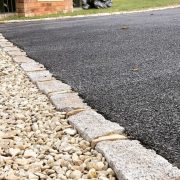
Good edging means concrete kerbs, block paving edgers, setts or treated timber, bedded and backed (or “haunched”) with concrete. It’s one of the cheaper parts of the job and one of the most important. It also does wonders for how the finished drive looks.
If the plan is to just rake the tarmac out to a feathered edge against the lawn, I’d be very wary. That’s a finish that starts failing almost immediately.
5. “Where will the water go?”
Tarmac is, for most practical purposes, waterproof. So every drop of rain that lands on your driveway has to go somewhere. The contractor needs a plan for where.
The drive should have a gentle fall so water runs off rather than pooling. It must fall away from the house, never towards it. Where the drive meets the house, the finished surface should sit at least 150 mm below the damp-proof course. I’ve seen beautiful new driveways cause damp problems inside the home because someone raised the levels without thinking.
At the low point, the water needs a destination: a channel drain feeding a soakaway, a permeable strip, a rain garden or a lawn. Not the public footpath, and not your neighbour’s garden. Ask the contractor to show you on the plan exactly where it goes.
6. “Do I need planning permission?”
Plenty of homeowners don’t realise this, and plenty of contractors are happy not to mention it.
In England, if you’re laying more than five square metres of new hard surface in a front garden, and it’s impermeable and doesn’t drain to a permeable area within your property, you generally need planning permission. A standard tarmac drive running off onto the street falls squarely into that category. Rules differ in Wales, Scotland and Northern Ireland, and listed buildings or conservation areas add their own wrinkles.
The simplest way round it is good drainage design: direct the run-off into a soakaway or planted area on your own land, or use a porous asphalt. A contractor who knows the rules will raise this before you do. One who shrugs it off is telling you something about how they work. If in doubt, check with your local council’s planning department before work starts.
7. “Will I need a dropped kerb, and who’s arranging it?”
If you’re creating a new access across the pavement, you’ll almost certainly need a dropped kerb, also called a vehicle crossover. You can’t just get your driveway firm to knock the kerb down. It needs approval from the local highway authority, and many councils insist the work is done by them or an approved contractor.
Driving over a full-height kerb without permission can land you with enforcement action, and you’ll be liable for any damage to the pavement. Ask the contractor whether the job involves the highway, and if so, who’s applying for consent. If they say “don’t worry about that”, worry about it.
8. “What exactly is the material, and where’s it coming from?”
A proper contractor buys fresh, hot asphalt from a named supplier’s plant on the day it’s laid. They should be able to tell you which plant and what product, something like a dense binder course and a fine-graded surface course to a recognised specification.
Every load comes with a delivery ticket. Ask to see them. It tells you what was supplied, how much and when.
What you should never accept is the doorstep classic: “We’ve got some tarmac left over from a job down the road, we can do your drive cheap today.” Asphalt is made to order and starts cooling the moment it leaves the plant. “Leftover” material is either a fiction or cold, half-useless stuff that will never compact properly. This line is one of the oldest scams in the book, and it still works far too often.
9. “How will you compact it?”
Compaction is what turns loose hot asphalt into a dense, durable surface. Under-compacted tarmac is porous, weak and lets water in, and water is the enemy of everything in a driveway.
For anything beyond a small path, I want to see a proper vibrating roller on site, not just a plate compactor. Plates have their place for awkward corners and edges, but they can’t match a roller across a whole drive. The sub-base should be compacted properly too, ideally in layers, before any tarmac goes down.
Ask what kit they’ll bring. Then, on the day, make sure it turns up.
10. “What happens if the weather turns?”
Hot asphalt and British weather have a difficult relationship. Lay it in heavy rain and the water gets trapped between layers and chills the material. Lay it in frost or on a frozen sub-base and it cools too fast to compact properly. Cold, windy days are surprisingly troublesome too, especially for thinner surface layers.
A good contractor will happily postpone rather than lay in bad conditions, even if it means a cancelled day for their crew. That’s a firm you want. One who tells you “it’ll be fine, we lay in all weathers” is prioritising their diary over your driveway.
Ask what their policy is, and get any rescheduling terms in writing.
11. “Can I have a written, itemised quote, and what happens to the waste?”
A proper quote isn’t a scribbled figure on the back of a business card. It should set out the area, the excavation depth, the sub-base type and depth, the membrane, the tarmac layers and their thicknesses, the edging, the drainage, and who’s handling the dropped kerb if there is one. It should also say who removes the spoil and old surfacing.
That last point matters more than you’d think. Excavating a drive produces tonnes of soil and rubble, and it has to be disposed of legally. A legitimate firm will have a waste carrier registration and will happily tell you where it’s going. Fly-tipping your old driveway into a country lane can come back on you as the householder.
Get at least three quotes and compare them line by line. If one is dramatically cheaper, it’s usually because something on that list is missing.
12. “What’s the guarantee, and how do you want paying?”
Ask how long the guarantee lasts and exactly what it covers. Sinking? Cracking? Drainage? Get it in writing. An insurance-backed guarantee is better still, because it protects you even if the firm stops trading.
Then talk money. A modest deposit for a big job is normal. Paying most or all of it upfront, in cash, before a spade has gone in the ground is not. I’d pay the balance only when the job is finished and you’ve inspected it in daylight.
It’s worth knowing your rights, too. If a contract is agreed at your home rather than at the trader’s premises, consumer law generally gives you a 14-day cooling-off period to cancel. A trader who pressures you to sign and start the same day is often trying to get round exactly that.
The red flags, in one place
If you skimmed everything above, at least remember this. Walk away from any contractor who:
- Knocks on your door uninvited, especially with “leftover” tarmac
- Offers a discount that only applies if you agree today
- Won’t put layer depths, sub-base and edging in writing
- Wants a large cash payment upfront
- Has no fixed address or verifiable references
- Dismisses questions about drainage, planning or the dropped kerb
- Plans to lay over the existing surface without checking it
Any one of these is a warning. Two or more and I wouldn’t let them near my house.
Saying it out loud
Here’s the thing nobody in this trade likes to say out loud. A good tarmac driveway costs more than a bad one, and it should. Most of that extra money goes into the parts you’ll never see again once the job’s done: the depth of the dig, the quality of the sub-base, the second layer of tarmac, the edging and the drainage.
That’s exactly why the cowboys thrive. They know you’ll judge the drive on how it looks the day they leave, and on that day a bad drive and a good one look much the same.
So don’t judge it on the day. Judge the contractor before they start, by how they answer these twelve questions. And once it’s laid, give it a bit of care. Avoid turning your steering wheel on the spot for the first few weeks, keep caravan jockey wheels and motorbike stands off it in hot weather, and clear weeds and moss from the edges before they get a foothold.
Do all that, and a properly laid tarmac drive should serve you well for many years. Skip it, and you’ll be reading articles like this one again sooner than you’d like.
–
Article by Jobling Purser Road Surface & Adhesive Experts in Newcastle & Carlisle UK.