 By Robin Amel
Can you bung a few speed bumps on a UK private road or car park?
If you’re the one who has to deal with a private road, a car park, or a residents’ committee, you’ve probably had that same annoying conversation a few times: “People are driving too blimey fast, can we just chuck some speed bumps in there then?” The short answer is that yes, you probably can. But don’t go rushing out to buy a load of rubber and get the drill out just yet – there are a bunch of legal hoops to jump through, design standards to follow, and practical headaches to worry about. This guide will give you the lowdown on all of the above.
Quick answer: You can stick speed bumps on a UK private road or car park that you own or look after.
You don’t need permission from the council to do it, because it’s on private land. Traffic calming devices like speed bumps provide a way to slow down the traffic, and they work a treat. You don’t need anyone’s permission to order them, and nobody from the council will be knocking on your door to ask you to sort it out.
The main difference is between a road that’s open to the general public (like a public highway) and a private road (that’s privately owned and only used by the people who live or work there). The Highways (Road Humps) Regulations 1999 apply to public highways, but if the public keeps driving onto your land (like supermarket car parks or visitor parking) then you’ve still got to follow a lot of the same rules in practice. Insurers, the courts, and just plain old common sense say you’ve got to follow similar standards when members of the public are involved.
Even on a road that’s totally private, you’ve still got a duty of care under the Occupiers’ Liability Act 1957. Speed bumps are designed to slow the traffic down to very low speeds, and that’s all well and good, but if you build one that just launches someone’s exhaust into orbit, you can bet your bottom dollar that’s going to lead to a lawsuit. So yes, you can do it – just make sure you get it right.
It’s easy to just use the phrase “speed bump” like it’s interchangeable with a whole load of other things, but there are actually a few different types of traffic calming devices out there, and getting the wrong one can lead to a lot of complaints. Here’s the lowdown.
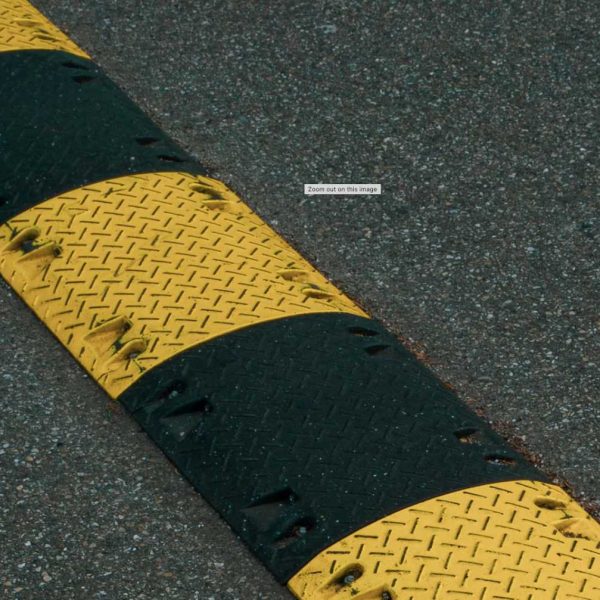
A classic speed bump is a sharp, short raised bit of road. Speed bumps are usually between 1 to 3 feet long and 3 to 4 inches high, and they’re designed to slow cars down to about 5-10mph. They’re pretty standard for car parks and loading bays where you want people to slow down. The most common type of speed bump you’ll find is a modular rubber one, typically bolted to the existing road surface in alternating black and yellow bits. Most UK suppliers will sell a speed bump kit that includes pre-drilled holes, expanding anchors, and reflective end caps.
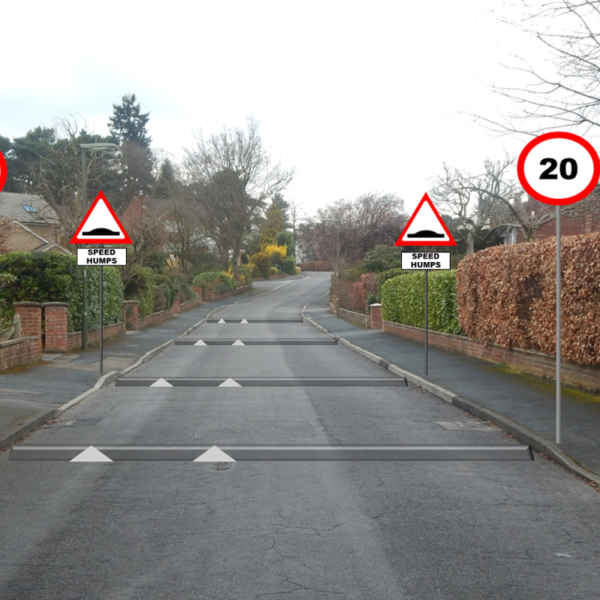
Speed humps (or road humps as some people call them) are broader and more gentle. They’re designed to slow traffic down to about 15-20mph, and they do it by reducing the speed by a teensy bit (around 8-10mph). They’re good for longer stretches of road where you want to slow the traffic down without rattling the fillings loose. You’ll see them on residential streets and private estate roads.
Speed cushions are little raised pads with gaps between them. Buses and fire engines can drive over them without slowing down because they’ve got wider axles, but cars have to ride over the top. They’re a pretty useful thing to have on bus routes or emergency access roads through private estates.
Speed tables are basically long, flat-topped platforms. They calm traffic to about 15-20mph and are a bit more comfortable to drive on, but they cost more and take up a bit more space.
And then there’s the question of what they’re made of. Rubber’s a quick and easy fix, but it’s not as durable as asphalt or concrete humps. Those take a bit more work to install and need proper drainage planning to avoid them getting all flooded.
Public highway vs private road vs “private but open to the public”
So the main thing to focus on isn’t who owns the road, but who drives on it.
A public highway is one that’s adopted by the council or highways authority. Any speed bumps or speed tables that you put on a public highway have to follow the Highways (Road Humps) Regulations 1999 in terms of height, spacing, signing, and consultation. Speed humps on public highways require special permission and you can’t just go and install them yourself. The Department for Transport has its own set of rules for road humps, and those have to be followed if you’re putting one on an adopted road.
A private road with restricted access (like a gated estate or a staff-only yard) isn’t adopted. Highway legislation doesn’t apply directly, but there are still plenty of other rules you’ve got to follow, like the Occupiers’ Liability Act 1957 and what your insurance company expects of you.Then there’s the grey areas – private car parks and retail parks that welcome the general public onto their premises. A supermarket car park in Manchester that’s open all day to shoppers is private land, and as such is governed by UK law. However, if you install speed bumps there without following the proper guidelines, courts and insurers will judge you against what a reasonable car park operator would do. You can’t ignore DfT guidance on dimensions and visibility – doing so is a serious risk. Take for instance a residents’ management company on a private cul-de-sac in Surrey, where only homeowners and their occasional guests use the road. The safety bar may be lower in this case, but it’s still firmly in place.
Key UK rules and guidance that still apply on private sites
You don’t need to be a law expert, but knowing the main references before installing speed bumps on private land is a good idea.
The Highways (Road Humps) Regulations 1999 set the benchmark that everyone – including your insurers and the courts – will measure your speed bumps against. The key specs here are: humps must be between 25 mm and 100 mm high, with no vertical faces over 6 mm high, and a minimum length of 900 mm in the direction of travel. These figures apply to public roads, but they’re the standard by which private sites are also judged.
The Department for Transport’s Local Transport Note (LTN) 1/07 on traffic calming is a detailed guide to hump profiles, spacing, signing and effectiveness. It suggests that humps should be 75 mm high in 20 mph zones, spaced at 60-70 m, and never more than 150 m apart. Speed cushions come in at a width of roughly 1,700 mm, with spacing of about 70 m – that seems to have dropped vehicle speeds down to around 22 mph in one study.
The Occupiers’ Liability Act 1957 is the big law for private landowners. If you create a hazard on your land, you’ve got to take reasonable steps to make it safe and visible to lawful visitors. Its partner, the Occupiers’ Liability Act 1984, extends a limited duty of care even to trespassers. These two acts mean that if you install a bump that’s not signed, lit, or properly maintained, you could end up in court.
A private company usually doesn’t need a formal Traffic Regulation Order to calm traffic on its own car park, but following the standards used on public roads is still the safest and most insurance-friendly option.
Do you need permission to install speed bumps on private land?
On genuinely private roads and car parks, you usually don’t need council permission to install speed bumps. On private roads, you can put them up without any need for planning permission, and no traffic regulation order is required. However, “no council permission” doesn’t mean “no homework” – you still need to do your research.
If the road is jointly owned (by a residents association, a management company, or shared access with a neighbour), check your deeds, lease or management agreement. Installing bumps without the freeholder’s consent could breach your lease terms.
Emergency services usually object to full-width bumps because they can cause delays for ambulances and fire engines. Delays like these are a problem if you have emergency vehicles regularly using your route. So, it’s a good idea to talk to your local fire service before installing anything. Speed cushions are often the preferred solution on emergency access roads because larger vehicles with wider axles can straddle them.
If there’s any chance the road might be adopted by the local authority in the future, have a word with the council first. Unapproved bumps could block adoption or need to be ripped out.
Your insurer may also want to see a risk assessment. Badly designed bumps that cause accidents or vehicle damage claims are the kind of thing that makes underwriters nervous.
Choosing the right traffic calming measure for your private road or car park
Installing random speed bumps isn’t the answer. The choice of device should match the speed problem and the type of road users you have.
Short car park aisles with lots of pedestrians – Speed bumps can slow vehicles to 5-10 mph on car parks. In shopping centres, lower, sharper rubber bumps near crossings and entrances are often a good bet – they’re clearly signed and promote safety. Lower vehicle speeds reduce the risk of accidents with pedestrians.
Longer private roads to offices, warehouses or schools – In these cases, speed humps often allow speeds of 10-15 mph, making them a better fit for stretches where a jarring 5 mph bump would be overkill. That’s why you see speed humps in school zones and residential areas to protect students and pedestrians.
Residential Estate Roads – Speed bumps are often a good way to discourage through traffic on residential streets. They do an excellent job of putting the brakes on drivers who are just looking for a shortcut. A series of speed humps can reduce traffic volume by a reasonable 20% and cuts crash rates by a quite significant 33 to 48%. If you get your speed bumps right they can also reduce the severity of accidents in local neighbourhoods. Just be aware though, that if you don’t get it right, speeding drivers will just transfer the problem to the next street along.
Bus Routes or Emergency Access Roads through Private Estates – Speed cushions or carefully spaced speed tables let buses and emergency vehicles pass through with ease while still slowing down the cars. It’s worth looking at other ways to slow traffic down as well. For example you could narrow the road with some clear markings, create some chicanes, put some coloured surfacing at the gateways or even just reduce the speed limit within your site by 5 or 10 mph, and sticking a clear sign at each entrance to make sure people know it.
Design Basics: Height, Spacing, Signing and Visibility
The thing is, badly designed speed bumps will just cause people to complain, wear out suspension and generally cause a whole lot of trouble. Good ones though, will just calm the traffic without a fuss.
Height
Speed bumps should cut traffic speeds down to around 10-15 mph. In car parks a 50 mm high bump will usually keep drivers to a 10 mph speed, while a 75 mm bump will keep them to about 5 mph. For humps and speed tables on access roads, a 75-100 mm high and a few metres long will allow you to cross comfortably at 15-20 mph. Speed bumps generally limit vehicle speeds to 10-15 km/h.
Spacing
If you space them too far apart they just accelerate in between; if you space them too close they create a whole lot of noise, pollution and just general frustration for drivers. Typically, speed bumps are put in 110-170 m apart on longer roads. LTN 1/07 suggests 60-70 m in 20 mph zones, but no more than 150 m. On private roads 60-100 m apart works quite well, with tighter spacing near entrances, bends and pedestrian routes.
Signing and Markings
Warning signs should be put up 20 m before each speed bump, even if they’re on private land. For the first speed bump on entering, a sign 20-30 m before will give drivers enough time to slow down. Some road markings (white triangles, arrows, chevrons on asphalt humps) are a big help at night. Modular rubber speed bumps often come in alternating black and yellow with built in reflectors.
Surface Depth
You’ll need a minimum surface depth of 100 mm to install your speed bumps. If your road surface is thinner or degraded then you’ll need to fix it up before you bolt anything down.
Practicalities: Installing Speed Bumps Safely
You might be able to install the modular rubber kind yourself if you’re a private landowner. Longer speed tables and humps on private roads usually require a bit more expertise and people with asphalt or concrete capabilities.
The general process is:
- Inspect the road and fix up any potholes or broken edges, make sure you’ve got at least 100-150 mm depth of concrete or tarmac.
- Mark out the locations with some spray paint. Check the clear sightlines and make sure it’s not going to be too close to any junctions, sharp bends or steep gradients.
- For rubber speed bump kits: drill some holes into the road, insert the expanding anchors, bolt down the segments and end caps, and make sure the bolt heads sit flush so you don’t trip anyone up.
- For asphalt or concrete road humps: use some formwork, hot asphalt or ready-mix concrete, get the right profile, add some high-visibility paint and road markings.
When you’re installing, make sure to put in some temporary traffic management if the road is in use, keep the pedestrian routes safe and signed.
Keep some records of when you installed it, the contractor you used, the product specs and any risk assessments, because if someone makes a claim, that’s your best line of defence.
Everyday Issues: Noise, Pollution, Vehicle Damage and Complaints
Nothing clears out an inbox like a brand new speed bump right outside someone’s bedroom window. Speed bumps are pretty cheap compared to big civil engineering projects, but the cost of complaints can really add up.
There’s increased noise and emissions with the stop-and-start driving that speed bumps bring. Vans and HGVs braking and accelerating over a line of closely spaced bumps at night will generate a lot of complaints. If the speed bumps are not well designed, they can cause noise, vibration and discomfort for everyone in the area.
Speed bumps can cause damage to vehicles if hit frequently at high speeds. Scraped exhausts, worn suspension and misaligned steering are common complaints, and if your bump is over what the Highways Regulations would allow on a public road (over 100 mm, or with a vertical face above 6 mm), you’re exposed to potential damage claims. In one TRL study 34 vehicles were possibly damaged by road humps over a single assessment period, with repair costs totalling around £7,500.Several UK councils have removed some pretty aggressive road humps after residents had a go at complaining about the noise and pollution. One speed bump in Norfolk ended up getting the chop at the cost of £30,000 – it was apparently too noisy for the locals to put up with.
To reduce problems on your own private site –
- Choose speed humps or tables instead of the big harsh bumps that can make traffic flow tricky, where constant movement is needed.
- Use fewer speed bumps, better-placed, alongside clear speed limits rather than a long stretch of “punishment” road.
- Make sure to keep your bumps in good nick so they don’t develop any sharp edges or gaps.
- Speed bumps will generally slow cars down to about 10-15 km/h (5-10 mph); if that’s slower than you need for your access road then just pick a gentler type of hump.
Alternatives and “next-generation” traffic calming on private sites
You don’t have to resort to raised lumps of rubber to keep traffic moving at a safe speed. Speed bumps are useful for slowing people down, but they aint the only tool in the box.
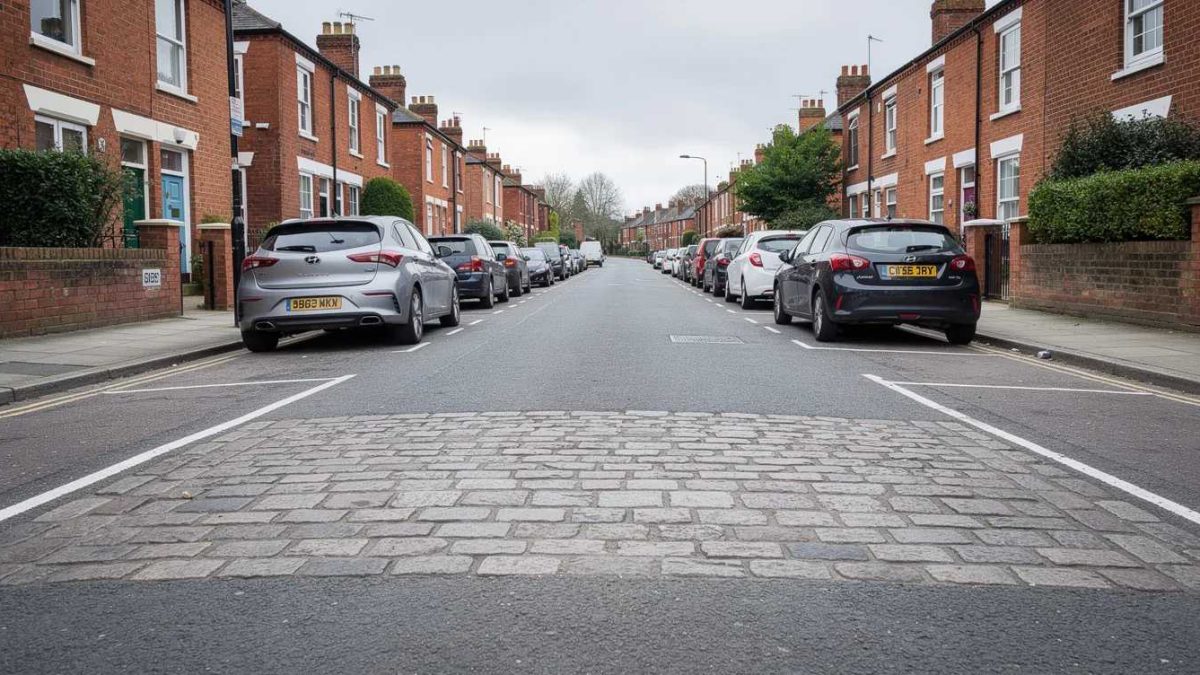
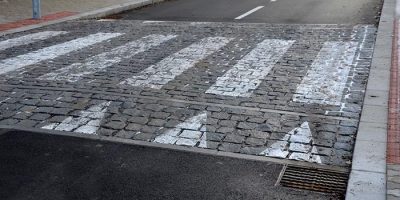
Stuff like raised pedestrian crossings (a speed table that doubles as a zebra crossing), chicanes, build-outs, mini roundabouts and narrowing down the gateways at site entrances are all established alternatives. You can also try psychological traffic calming tricks like coloured surfacing, different textures on the road surface, gateway signage and clear lane markings to slow people down without having to raise the road. Road crossings designed like this often work a treat in places like construction sites and logistics yards where heavy vehicles need to move smoothly.
But if you want to get a bit fancy then consider Dynamic speed bumps, which only spring into action when someone goes too fast. They use radar or sensors to stay flat for people whore driving responsibly but rise up for speeders. Then there are the liquid speed bumps which use special non-Newtonian fluids that feel soft at low speeds but firm up when you hit them hard. Both are a bit rare and expensive in the UK for now, and there are some unanswered questions about maintenance too. But for high-end business parks, university campuses or logistics hubs trying to avoid complaints then they might be worth taking a closer look at.
Checklist: before you go ahead and install speed bumps on your private road or car park
Before you even start digging, run through this list.
- Get a grip on the problem. Where exactly are people speeding, how fast and when? Get some real-life observations rather than just making an educated guess. Is it pedestrians that are at risk, or is it more about stopping accidents in lanes between parked cars?
- Check the ownership and legal status of the land. Who is in charge of the private road or car park? Make sure you know who owns it, who looks after it and who may have a say in what goes on there. And is it really not adopted highway?
- Chat to the stakeholders. Talk to residents, staff, tenants, the emergency services, delivery firms and buses. see if theyve got any special access needs.
- Pick the right traffic calming measures. Speed bumps for car parks, speed humps for access roads, speed cushions for emergency routes, speed tables for pedestrian crossing points, or a mix – and dont forget the signs and road markings.
- Check the basics. Make sure the heights, profiles, spacing and road surface are all up to scratch and that youve got suitable drainage and sightlines. Even though youre on private land, its a good idea to stick to the DfT-style guidelines.
- Plan out the installation. Schedule the work, sort out any temporary traffic management, and draw up a simple plan for keeping everything in good nick.
Used right, speed bumps and traffic calming measures can calm traffic down and keep pedestrians safe on UK private roads and car parks without turning every journey into a white-knuckle ride. start by understanding the problem, checking youve got the right to install anything, picking a suitable device, and getting the installation right. Your visitors will thank you – and your insurer will breathe a sigh of relief.